
Long Division Calculator with Remainders
Share this Calculator & Page


Calculator Use
Divide two numbers, a dividend and a divisor, and find the answer as a quotient with a remainder. Learn how to solve long division with remainders, or practice your own long division problems and use this calculator to check your answers.
Long division with remainders is one of two methods of doing long division by hand. It is somewhat easier than solving a division problem by finding a quotient answer with a decimal. If you need to do long division with decimals use our Long Division with Decimals Calculator.
What Are the Parts of Division
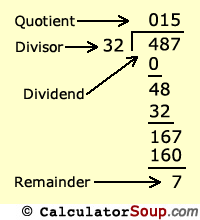
For the division sentence 487 ÷ 32 = 15 R 7
- 487 is the dividend
- 32 is the divisor
- 15 is the quotient part of the answer
- 7 is the remainder part of the answer
How to do Long Division With Remainders
From the example above let's divide 487 by 32 showing the work.
Long Division
Step-by-Step
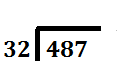
Set up the division problem with the long division symbol or the long division bracket.
Put 487, the dividend, on the inside of the bracket. The dividend is the number you're dividing.
Put 32, the divisor, on the outside of the bracket. The divisor is the number you're dividing by.
Put 487, the dividend, on the inside of the bracket. The dividend is the number you're dividing.
Put 32, the divisor, on the outside of the bracket. The divisor is the number you're dividing by.
Divide the first number of the dividend, 4 by the divisor, 32.
4 divided by 32 is 0, with a remainder of 4. You can ignore the remainder for now.
4 divided by 32 is 0, with a remainder of 4. You can ignore the remainder for now.
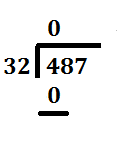
Put the 0 on top of the division bracket.
This is the beginning of the quotient answer.
Next, multiply 0 by the divisor 32 and insert the result 0 below the first number of the dividend inside the bracket.
0 * 32 = 0
This is the beginning of the quotient answer.
Next, multiply 0 by the divisor 32 and insert the result 0 below the first number of the dividend inside the bracket.
0 * 32 = 0
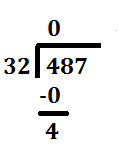
Draw a line under the 0 and subtract 0 from 4.
4 - 0 = 4
4 - 0 = 4
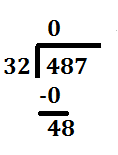
Bring down the next number of the dividend and insert it after the 4 so you have 48.
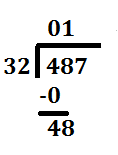
Divide 48 by the divisor, 32. The answer is 1. You can ignore the remainder for now.
48 ÷ 32 = 1
Note that you could skip all of the previous steps with zeros and jump straight to this step. You just need to realize how many digits in the dividend you need to skip over to get your first non-zero value in the quotient answer. In this case you could divide 32 into 48 straight away.
48 ÷ 32 = 1
Note that you could skip all of the previous steps with zeros and jump straight to this step. You just need to realize how many digits in the dividend you need to skip over to get your first non-zero value in the quotient answer. In this case you could divide 32 into 48 straight away.
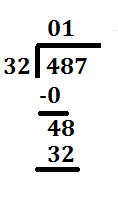
Put the 1 on top of the division bar, to the right of the 0. Next, multiply 1 by 32 and write the answer under 48.
1 * 32 = 32
1 * 32 = 32
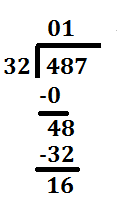
Draw a line and subtract 32 from 48.
48 - 32 = 16
48 - 32 = 16
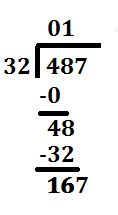
Bring down the next number from the dividend and insert it after the 16 so you have 167.
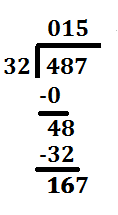
Divide 167 by the 32. See a pattern emerging?
167 ÷ 32 is 5 with a remainder of 7
167 ÷ 32 is 5 with a remainder of 7
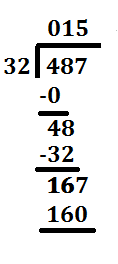
Put the 5 on top of the division bar, to the right of the 1. Multiply 5 by 32 and write the answer under 167.
5 * 32 = 160
5 * 32 = 160
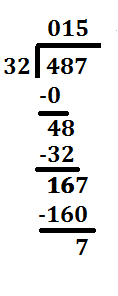
Draw a line and subtract 160 from 167.
167 - 160 = 7
167 - 160 = 7
Since 7 is less than 32 your long division is done. You have your answer: The quotient is 15 and the remainder is 7.
So, 487 ÷ 32 = 15 with a remainder of 7
For longer dividends, you would continue repeating the division and multiplication steps until you bring down every digit from the divdend and solve the problem.
So, 487 ÷ 32 = 15 with a remainder of 7
For longer dividends, you would continue repeating the division and multiplication steps until you bring down every digit from the divdend and solve the problem.
Further Reading
Math is Fun also provides a step-by-step process for long division with Long Division with Remainders.